Regridding Satellite and Model Data to DGGS Using the Pangeo Ecosystem#
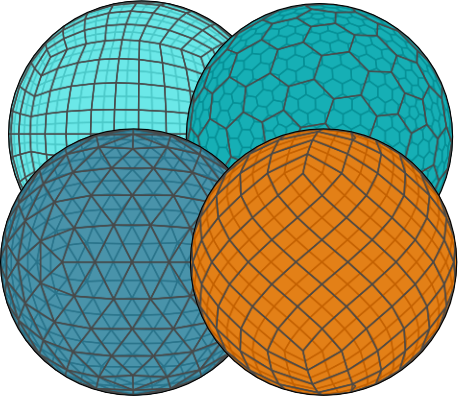
Welcome! This Jupyter Book presents a practical evaluation of different Python-based regridding tools for mapping geospatial datasets to Discrete Global Grid Systems (DGGS), particularly HEALPix and H3.
Objectives#
Understand the fundamentals of regridding and its role in comparing gridded data.
Explore offline, area-based regridding techniques.
Compare regridding tools available in the Pangeo ecosystem:
xesmfuxarraygrid-weights
Evaluate their compatibility with DGGS such as HEALPix and H3.
Why DGGS?#
DGGS provide a hierarchical, equal-area tiling of the globe and are increasingly used in Earth observation and climate modeling. HEALPix, originally developed for astrophysics, offers excellent characteristics for global-scale geoscientific applications.
Structure of the Book#
This book is divided into the following sections:
Citation#
This work is developed by researchers at LOPS, CNES, and Development Seed [MDZ+25].
References#
Justus Magin, Jean-Marc Delouis, Lionel Zawadski, Julien Petiton, Max Jones, and Tina Odaka. Regridding satellite and model data to dggs (healpix) using the pangeo ecosystem. March 2025. URL: http://dx.doi.org/10.5194/egusphere-egu25-18285, doi:10.5194/egusphere-egu25-18285.